
Bikes to watch by Any Saunders
AHRMA has thirteen separate vintage classes (in addition to BEARS, the Battle of Twins classes and Sound of Singles), and sometimes two or even three classes will race together, usually in a multi-wave start. This can lead to some very confusing racing, so here's a guide to sort the bikes out.
Premier Vintage racing's #1 class. The Premier class champion holds the number one plate in vintage racing. Some of the bikes that race in this class have seen action in GPs and national level AMA competition in the fifties and sixties. Others, like many of the Matchless G50 racers you'll see on the track, are faithful replicas of race bikes of the time. Period modifications are allowed, meaning you'll see huge four- or even eight- leading shoe drum brakes on the front wheels of some racebikes. Back in the sixties, drum brakes were still the norm, and brake fade during a race was a constant problem. These huge brakes helped, but weren't as effective as today's brake discs. What you won't see are the internal engine modifications that allow the Premier class bikes just that little more horsepower than they had back in 1965. This modicum of extra power lets the bikes take advantage of today's stickier tire compounds, although the tires are narrow by modern standards, since the wheel rims must be the same size as original. Look for a real mixture of machinery in this class, as riders bring out German, Italian, British, American and Japanese brands. Around the high-speed corners of Willow Springs, the horsepower of twin-cylinder Japanese and German machines may overpower the single-cylinder British Matchless, AJS and Norton racers-but don't bet on it. All bets are off, however, if any million-dollar MV Agusta motorcycles turn up. These race-bred machines won every championship in their day (a total of 37 world championships) and are very, very fast.
350GP In this class you may see some of the multi-cylinder machines that dominated racing in the 1960s - MV and Honda-competing against rather more down to earth classics. At Daytona this year, this class was won by six-times World Champion Jim Redman, riding in his first race for over 25 years, on Team Obsolete's 350cc MV Agusta four cylinder. Team obsolete also regularly race a Benelli 4 cylinder and an extremely rare Honda 350cc six in this class. If any of these exotic machines turn up at Willow springs, look for them to go faster than most of the machines in the Premier class race.
Formula 750 Here's where you'll see hotted up twins, triples and fours from the sixties and seventies. This is the class that allows the tricked-out Ducati, Norton and Triumph twins to race against the occasional MV and Harley's XR750, and Honda's CR750, based on the old CB750 four cylinder. This is the racing class that was the precursor of Superbikes, and way back in the Seventies, just after Honda's ground-breaking 750 four came out, every motorcycle factory tried to make their 750 compete with Honda's. Those spectators with a few gray hairs will remember the Daytona battles between Rayborn, Mann, Agostini and Nixon. Those were the days of the Triumph and BSA triples doing battle with Harley's then-new XR750, and those days are recreated in this class.
Formula 500 Probably the most significant bike in 'seventies racing was a simple two stroke, Yamaha's 350cc TR3. Despite its size disadvantage, the Yamaha was a clear winner in its day. Its riders often defeated machines twice the TRs size, and more, and were often faster than the best 750cc four strokes in a straight fight. The end of the classic four-stroke era in American racing came at Daytona in 1972, when Don Emde brought one of the tiny Yamahas to the winner's podium for the first time. Never again would big four-stroke twins, triples or fours rule the roost. It was the start of an era of two-stroke racing domination which continues to this day. It's fitting, then that the winners of the Formula 500 race are usually Yamaha mounted, and it's entirely understandable that these potent racebikes aren't allowed to compete in the premier class; they'd clean up.
Formula 250 This class is largely populated by two stroke twins up to 250, two stroke singles to 360cc, Honda CB350 twins, and Honda CF350F fours. All motorcycles in this class must be fully GP kitted, and the cutoff date, as with all AHRMA racers, is December 31, 1972. You'll see a lot of Yamahas in this class, since so many of them qualify. RD125/200/250, TD2, TD2B, TD3, TA250, TA125, and the RD56/TD1 "works special." Yamaha bikes dominate this class, usually the TD3. But you'll also see Kawasaki A1Rs, 350 bighorn singles, F5s, F9s, and Aermacchis. A lot of names most people associate with dirt bikes find their way into Formula 250, such as Bultaco, Can-Am, Maico, and Ossa. As with all the GP classes, engine modifications are unlimited, as long as period components are used and class displacement isn't exceeded.
750 Sportsman The Sportsman classes are the vintage equivalent of Superbikes. They allow modified street machines to compete, although the level of modifications is limited, to keep the costs down and the racing fair. It's a popular twin-cylinder class, with the front runners typically BMW, Norton or Triumph mounted. Cutoff date for the class is 1973, which means that the models you see out on the track must have been designed and available for sale before that date (although if they were manufactured without major changes after 1973, it's legal to use a later model). This is one of AHRMA's most popular classes, because speeds are high while the costs are low (it's much easier and cheaper to modify a $2,000 street bike than to find a genuine $10,000 + period racing machine). Like the other vintage classes, though, changes are limited, so you won't see any ultra-wide tires or three-spoke magnesium alloy wheels in this race. Look for a close competition here, as the fast parts of the track will favor the big BMW twins, while the tight nadgery parts give the advantage to the lightweight British and Japanese twins.
500 Sportsman One step down on the evolutionary ladder from the Premier class, 500 Sportsman allows race-kitted street bikes to compete. Here's where you'll see a cracking match between Honda 450 twins and Triumph twins or BSA singles. Sometimes the bikes will be $1,000 specials, but more often than not they'll be the result of thousands of dollars in monetary costs and many late nights work. Given a good rider though, that $1000 special can sometimes embarrass the owner of the $15,000 special.
350 Sportsman If there's one class dominated by Japanese machinery in vintage racing, 350GP is it. The Honda twins have proven particularly competitive in this street-based class, although that doesn't mean they have a lock on the racing. A particularly rapid BSA single or Triumph 350 twin may wrest the lead away from one of these twins.
pre-40 One of the true sights of vintage racing is watching a 1926 Indian scout tracking round a corner, inches away from a fifty years younger Yamaha. There won't be too many of the really ancient machines entered, but expect to see a good sample of pre-world war 2 machines on the grid. The Harleys and Indians are hand-shift models, with the gear selector for their crash gearbox mounted on the gas tank, and the clutch operated by a foot pedal. If you see the rider take his hand off the handlebars, it's to change gear! The British, German and Italian machines in this class are generally equipped with foot-shift gearboxes, which came into vogue in Europe in the late 'twenties and early thirties. This difference makes for a wholly different riding style. The European bike riders can change gear during, or after a corner, while the Harley and Indian riders must make all their changes-by hand-before they start to turn, in case the rear wheel locks up when they shift. At the same time, they must coax the maximum possible stopping power from their narrow drum front brakes. If this makes the race sound like a combination wall of death and bucking bronco ride, then you've got the picture. Pick a spot on the Omega to watch this race, and you'll see some exciting action.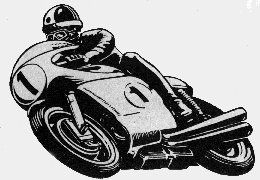
Class C Class C racers ride machines eligible for AMA national competition in the fifties and sixties. American racing rules, being dirt-track oriented, were always different from European road-race oriented regulations, and you'll see the contrast in this class. AMA's class C started in the depression, as a way to race cheaply, and entry was limited to 500cc overhead valve and 750cc sidevalve machines. These rules bred a whole class of Harley-Davidson racers, including the WR-model and the KR750, which were raced until the seventies. The big side-valve machines may seem antiquated, but they make up for their heavy weight and low compression ratios with a spread of stump-pulling torque that tugs them rapidly out of the corners. In the right hands, one of these sidevalvers can be more than a match for the smaller, more nimble British singles or German BMW twins that form their main competition. Look for vastly different lines through Willow's fast corners as the singles riders try to make up their horsepower disadvantage, and the big V-twin racers take advantage of big, slow revving motors to get the speeds up on the straight.
Classic 60s Another popular class, one that encourages racers of unmodified sixties racers to get up and have a go. What this means is the racers must compete with frames, forks and more importantly brakes that are identical to the 1960s versions. The motorcycles may look similar to the premier class machines, but they have brakes that are good for maybe ten hard stops before they fade to nothing. Look for cornering speeds to rise during the event because of this. Note that while many of the bikes competing in this event are genuine sixties race bikes, some of the Matchless G50s and Manx Nortons may be modern replicas. They are allowed to compete if they are exactly the same as the models produced during the 1960s, and of course they must use the same drum brakes as the older bikes. You can truly appreciate the advances made in modern brakes and modern frame technology as you watch some of these bikes wobble and twist through the bends-truly an exciting ride for those brave enough to try it!
Formula Vintage Formula Vintage is a free-for-all. Run what you brung (as long as it's eligible for one of the other classes). Here's where you'll get the answer to the question, "What's the fastest vintage bike?" At Willow Springs, we'll just have to wait and see. At the other circuits AHRMA races on, the match between Premier 500 and 750 Sportsman classes is a close one. A good rider on either bike could take first place. But don't rule out the two strokes: these have separate classes in the rest of AHRMA racing, but Formula Vintage is a chance to show just how fast a good-running Yamaha TR3 can be (and that's quite fast enough to show a clean pair of heels to a 750 four stroke). Who gets the win is often down to rider cunning and skill, because the different classes all have different lines, and the rider who works out how to ride the course to his best advantage is likely the rider who'll take the checkered flag.
250GP Little doubt what'll win this race-it'll probably be a little Duck. The 250cc Ducatis singles dominate this class. Their 250cc bevel-drive overhead camshaft engines putting out a surprising amount of horsepower (enough for the little bikes to be a major factor on the 350GP class, too). These tiny bikes, too small for anyone above average size to ride, are the ancestors of today's Ducati 916s, as ridden to last year's World Superbike Championship by Carl Fogarty and US Championship by Troy Corser.
200 GP The battle in this tiddler class usually rages between custom made two strokes and slightly bigger four strokes: the thumpers are allowed to bust the capacity barrier by 50cc, although that isn't usually enough to overcome the two-strokes. Look for some tight racing, with Yamaha, Ducati, Bultaco and Aermacchi battling for the lead, although all bets are off if Sven Bley turns up with one of his extremely rapid motocross based Maico racers.
Battle of the Twins First of all, in AHRMA talk, battle of the twins is BOT, and not BOTT. It's a modern class, and in the US, AHRMA is the homolgating body for the only national twins series. BOT is divided into a number of segments, so that twins of all sizes can come out and play. This is a modern bike class, and cutting edge bikes dominate it. Open Twins is only run when enough bikes pre-register, and these bikes are special. World class Superbikes such as the Doug Polen Replica and those wonderful Kiwi hand crafted Brittens are what it takes to put on an Open Twins race. The regular Formula 1 Twins race is an unlimited displacement class, as long as they are based on US production roadgoing bikes, such as the Ducati 916, 888, and 851. Moto Guzzi Daytonas - the other bright red Italian bike - are perfect for the class, as are R1100 based Bimmers. But size isn't everything, and you'll find some odd bikes in Formula 1 Twins, such as the TDM 850 powered machines that Over Racing will be fielding at Corsa MotoClassica. Formula 2 Twins can be up to 1200cc, as long as they are pushrod actuated, and the limit for OHV engines is 750cc. This class is dominated by big old Guzzis and Ducati 750s. This is also the place to race big Sportsters. Surprisingly, even the beveled gear Ducatis can make a good showing in this class. That's the joy of racing, you know - a good rider and careful tuning can make up for a lot. Formula 3 limits displacement to 650cc for overhead cammed motors, which means Shell motored XS650s, Honda Hawks, and some mean bored out EX500s and the odd GS500. But you'll also find a lot of other twins converted to full race, because building a twin is a lot simpler than a multi cylinder bike. The only thing easier is a single. Two Stroke Twins are limited to 500cc on air cooled bikes, and 400cc for water cooled twins. The water cooled twins, by the way, are limited to pre-1985 bikes with tubular steel frames. There are a lot of custom bikes that could be built just for this class, but the most common entries are RD Yamahas.
Sound of Singles There's nothing as pure and simple as racing a single cylinder motorcycle. And there's nothing like the sound of a field of singles dropping the clutch for the holeshot at the beginning of a singles race. You don't need a guitar to make sweet music. There are four classes of singles races in AHRMA, run either in waves or separately, but they are scored separately. This series is divided into four classes, so that all the different species of single can compete. Most singles racers just love to race, no matter what, so a lot of the entries will "bump" into a higher class. Singles Formula 3 bikes are limited to 350cc motors. This class was formerly known as Junior, and Formula 2 was known as Senior. Formula 2 means 4 valve motors up to 510cc, and 2 valve motors up to 610cc. Honda FT500 Ascots and Yamaha SR500s are still popular singles racers, and you can expect all the local 500 singles racers to be out there. Their big brother SRX6s, unfortunately, have to run in Singles Formula 1, which is an unlimited four stroke single class. A single cylinder engine, as we know, is inherently limited by the primary imbalance of it's single piston. But that hasn't stopped the development of the single cylinder motorcycle engine. High strung SRX singles can make 70 horses before they start blowing up, and there are other big singles. Southern California's own Ron Wood makes one of the finest racebikes in the world (check out the welds on the frame while you're in the pits) and there are a number of dirtbike based motors such as the KLR650 and big Husquavarnas. The Ducati Supermono is eligible for this class, and Team Over Racing is scheduled to show up with Genesis five valve powered singles racers. You might want to take a look at their signature oval section alloy frames, too, and you definitely won't want to miss the race.
BEARS BEARS stands for British European American Racing Series, and it is a class for bikes with three or fewer cylinders. Displacement is limited to 1300cc, which is almost too much for a roadracer anyway. BEARS also prohibits Desmodromic valve actuation. Rotary engines are permitted, and but not supercharging or turbocharging. Oh, and Japanese frames and engines are prohibited. The Bears class was invented by jaded Europeans tired of the big four and Ducati taking everything in sight. And it was obviously created with Triumph's triples and Nortons wankel in mind. The class has proven to be enormously popular on the other side of the pond. The thing that makes Bears racing neat is that ,other than the restrictions listed above, anything goes. The class is loved for the innovation it encourages. Little guys can go ahead and build something and not have to worry about being badly stomped by Japanese R&D teams and those pesky new Ducatis (although Bevel drive Ducatis are often raced). Bears racing means weird Moto Guzzi torque beasts and wild bikes wrapped around BMW twins. Racers show up with numerous alternate front ends, such as the Telelever-type front end design from Saxon that predates the R1100 series. BEARS racing incorporates most open class twins and all singles along with the triples, which means that it generally has big fields. It's lotsa fun.


